
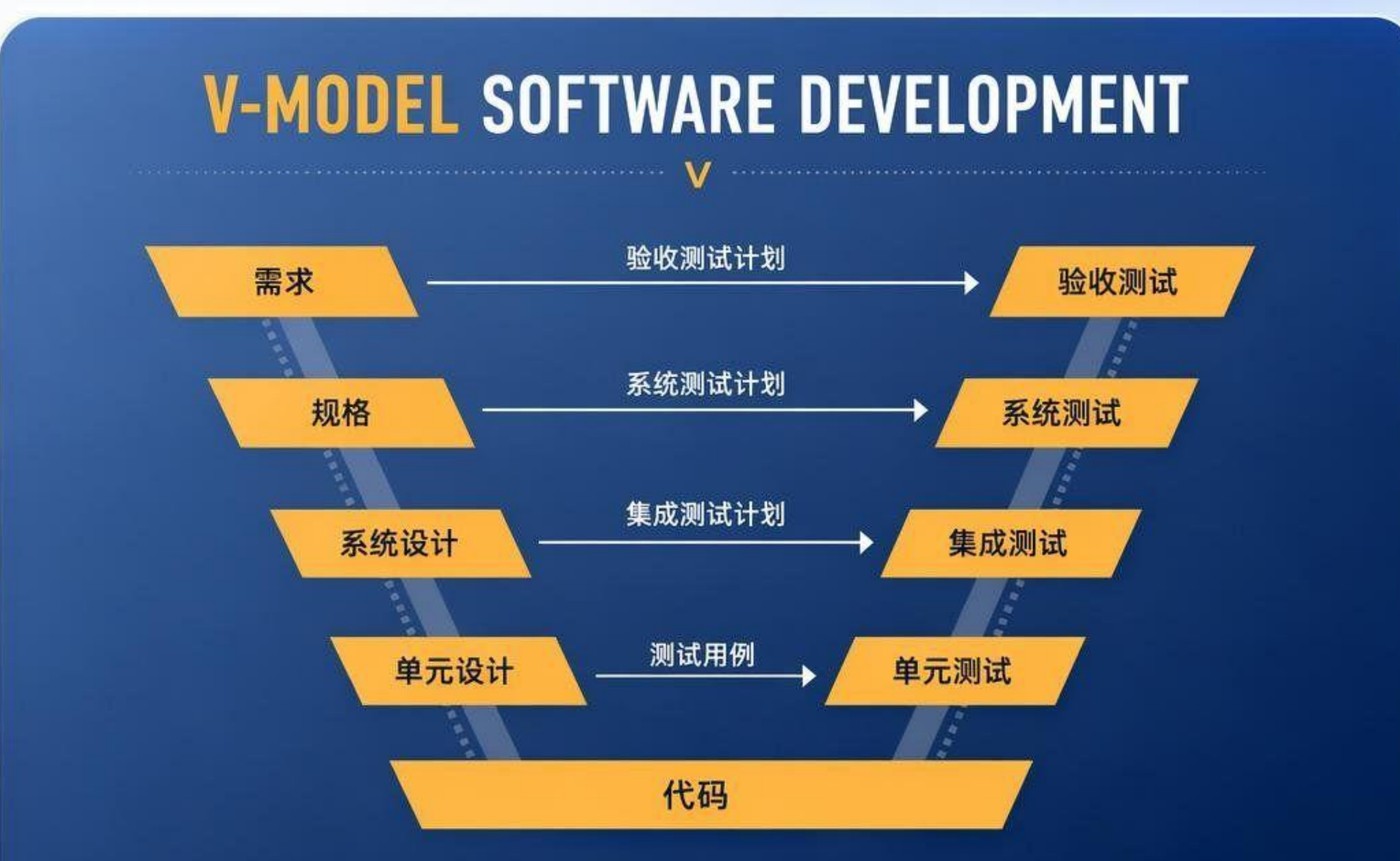
V-Model Software Development
Requirements → specification → system design → unit design → code, each mapped to acceptance, system, integration and unit testing.
Model-Based Design (MBD)
Control strategies developed as models: the model is the specification, simulation is the verification — fewer coding defects.
XCP Calibration
XCP-based calibration for online measurement and parameter tuning, accelerating control convergence and vehicle matching.
Performance Optimization
Focused technical breakthroughs for system performance and reliability.
Rotor position observation
Rotor position correction across the full speed range for higher torque accuracy.
Variable switching frequency
Full-range frequency control reduces MOSFET switching losses.
Five-segment modulation
Switching losses reduced by 30%.
Dead-time compensation
Higher current control accuracy and flatter torque output.
Dyno calibration
Full-speed current optimization on the test bench improves system efficiency.
Over-modulation
+4% output at equal voltage and speed; 15 ms peak torque step response.
Safety Assurance
Scalable ASIL-B functional safety architecture prevents unintended vehicle torque.
- Scalable ASIL-B architecturePrevents unintended torque; safety mechanisms extensible
- High-accuracy torque estimationFlux-linkage based, ±3 N·m accuracy — enables torque monitoring
- Defined safe statesFaults drive the system into ASC or FW states
- Fast hardware protectionOver-current and under-voltage protection reaches safe state rapidly
- Fault records & freeze framesInstantaneous data captured for root-cause analysis
- DC-link voltage controlController kept within its safe voltage window
Torque safety framework
- Torque commandReceives the vehicle torque request
- Torque processingMonitored using motor position and phase currents (I_A/I_C)
- Executed torqueTorque decomposition and fault response on anomaly
End-to-end monitoring ensures no unintended torque output.
NVH Optimization
Five techniques suppress inherent motor noise and driveline shuffle for automotive-grade refinement.
Active damping
Counteracting force suppresses low-frequency driveline oscillation.
Cogging torque handling
Compensates driveline lash during vehicle launch.
Torque zero-crossing control
Suppresses shuffle during gear shifts and regeneration transitions.
Dither frequency design
Reduces noise from low-order frequency excitation.
Harmonic injection
Suppresses motor inherent-frequency noise; validated up to 2,500 rpm.
Measured verification
Before/after waveform comparisons quantify the improvements.